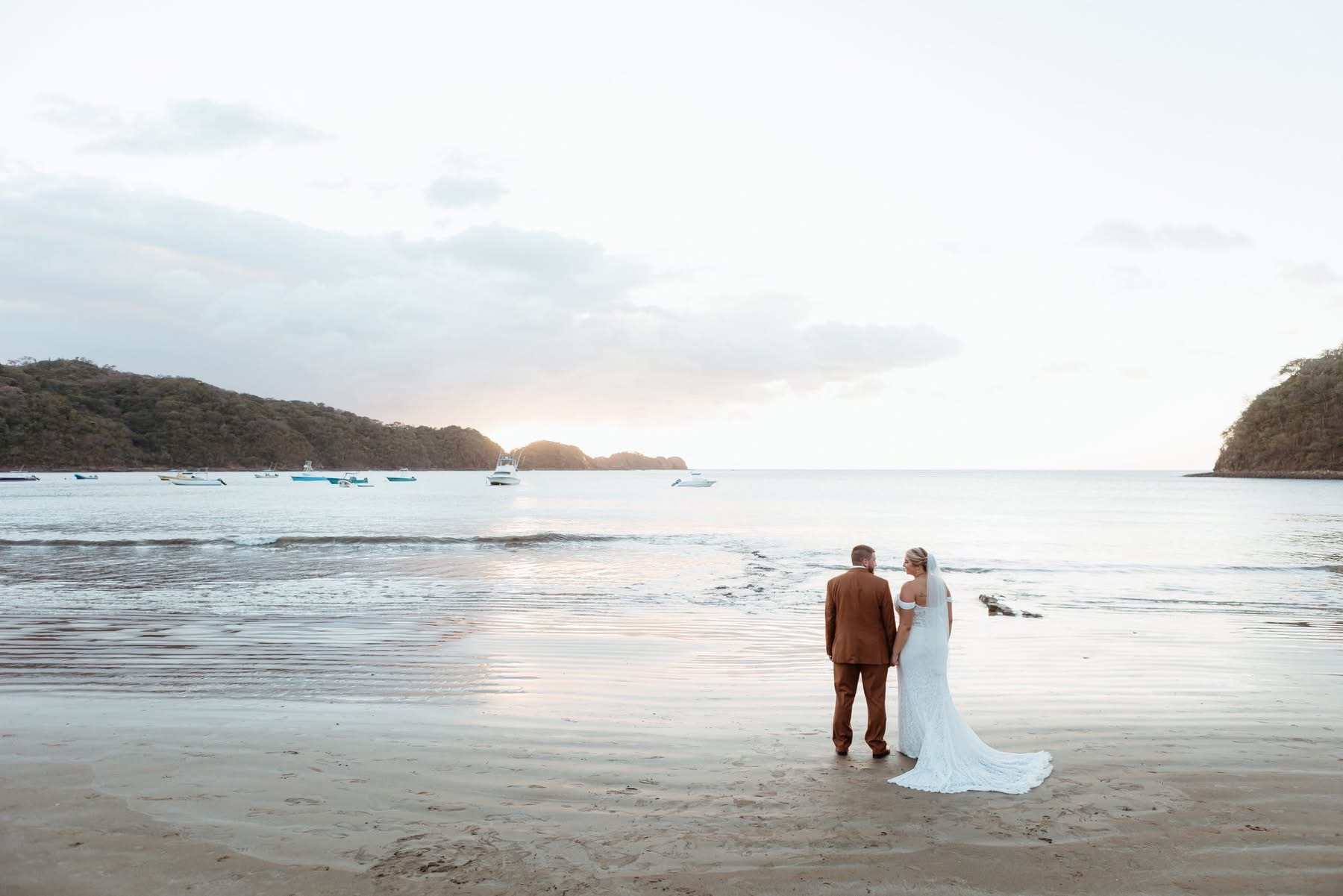
What is a first look at a destination wedding, and why is the question different from a home wedding?
A first look is a short, deliberately planned private moment before the ceremony where the couple sees each other for the first time in their wedding attire — usually 60 to 90 minutes before the aisle, in a scenic spot on property, with only the photographer (and often the videographer) present. It's not a rehearsal and it's not a photo op in the ordinary sense. It's a real emotional moment moved out of the ceremony and into a private setting, and the photographer works quietly enough that you're mostly aware of each other, not the camera.
At a destination wedding, the calculation is different from a home wedding in three specific ways. First, the ceremony window is usually driven by sunset — most beach and terrace ceremonies are scheduled 90 to 120 minutes before sundown so the light is right for photos, which leaves a tight portrait window between the ceremony and sunset dinner. Second, guests are already on vacation and typically arrive at the ceremony directly from the beach or pool; a long post-ceremony portrait session while they wait through cocktail hour is more visible than at a home wedding. Third, travel-day nerves stack on top of wedding-day nerves — you've been coordinating a trip for months, guests started arriving days ago, and there's a real value in a quiet moment together before the day gets loud.
None of that makes a first look the right answer automatically. It just means the trade-offs are sharper than at a home wedding, and the decision deserves a real conversation instead of a default.
Why do some couples still want a traditional aisle reveal at a destination wedding?
Because the aisle reveal is the single most iconic moment in a wedding, and for a lot of couples it's the moment they've been imagining for years. Walking down the aisle at your destination wedding — on sand, under a palapa, on a garden path, on a cliffside terrace — with your partner turning to see you for the first time, in front of every person you love, is a legitimately incredible experience. The gasp, the tears, the reaction from the guests — it's a scene that a first look, by design, cannot replicate.
The traditional path also honors the shape of the ceremony itself. When the first look happens at the aisle, the ceremony becomes the emotional peak of the day, and everything after it — cocktails, dinner, dancing — flows down from that moment. Couples who love the classical structure of a wedding often love this version specifically because the ceremony carries its full weight.
The origin story of the tradition is honestly not much of an argument for keeping it. The 'don't see each other before the ceremony' rule dates to the era of arranged marriages, when a covered veil was designed to prevent a groom from backing out after seeing his bride for the first time. That reasoning is obviously not relevant today. But traditions can outlive their original justification and still mean something — the aisle reveal became iconic because the moment itself is powerful, not because the runaway-groom logic is still valid. Choosing it because it feels right, not because it's expected, is a completely legitimate answer.
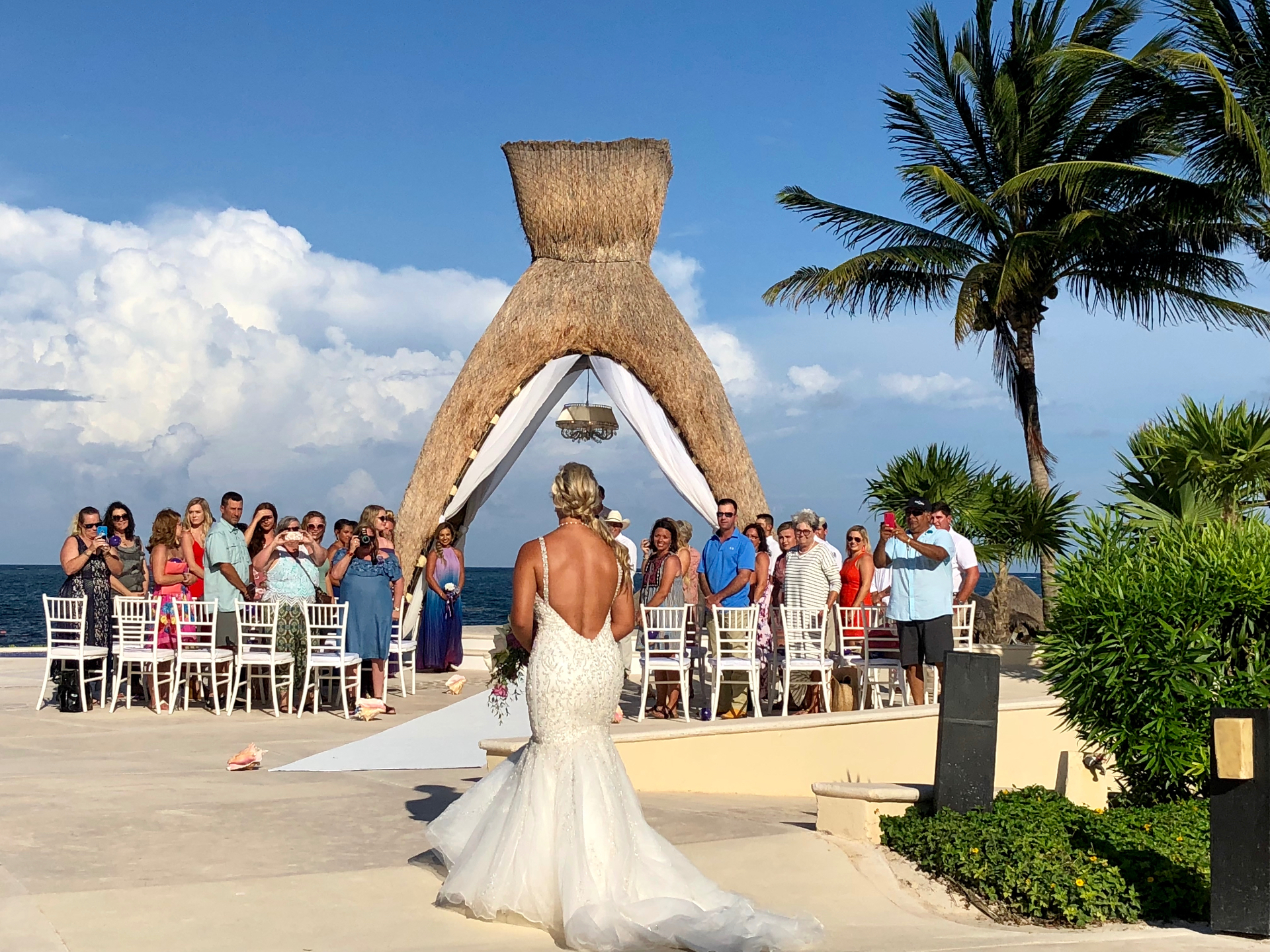
Why has the pre-ceremony first look become so popular for destination weddings?
Because it solves several destination-specific problems at once. A first look happens in a controlled, private setting — a suite terrace, an empty ceremony site, a garden path — and it gives the couple a full, unhurried moment together before the day compresses. There are no guests watching, no procession to time, no officiant waiting. It's just the two of you and, quietly in the background, your photographer.
That single decision cascades through the rest of the day. Because most portraits — couple photos, wedding party photos, and often family photos with the immediate family — can be done in the 60 to 90 minutes after the first look, the post-ceremony window opens up. Guests don't sit through a 90-minute cocktail hour while the couple disappears. The couple can walk into cocktail hour immediately after the recessional and actually experience it. The reception often starts earlier and feels more relaxed because the couple isn't running on adrenaline from a compressed portrait sprint at the tail end of golden hour.
The emotional case is real too, and it's the part couples underestimate. Couples who do a first look almost always describe the day afterward as feeling calmer, more present, and more like each other than they expected. The private moment takes the edge off the nerves — you've already seen each other, you've already cried once, you've already had a full sentence of conversation before the ceremony started. When you get to the aisle, the emotion is still there, but it's the calm, grounded version of it, not the raw shock version. That's a preference, not an improvement, and it's worth being honest with yourself about which one you actually want.
How does a first look actually change your destination wedding photography?
It changes the day's photo timeline more than any other single decision. In the no-first-look version, the couple sees each other at the aisle, and every photograph that requires them to be together — couple portraits, wedding party group shots, extended family formals, sunset portraits on the beach — has to happen in the roughly 60 to 90 minutes between the recessional and the reception seating. At a destination wedding scheduled around sunset, that window is genuinely tight, and it usually means the couple misses most of cocktail hour and works through what should be a decompression moment.
In the first-look version, that same portrait work is broken across the day. The photographer captures the first look itself, then moves the couple through most portraits, wedding party photos, and often the immediate-family group shots in the 60 to 90 minutes before the ceremony. After the ceremony, only a handful of remaining group shots need to happen — extended family, guest table shots, ceremony-site portraits at sunset if the light demands it. The rest of the couple's day is free.
The photography quality often improves too, for a specific reason: the light is more workable earlier in the afternoon than it is in the post-ceremony rush. Portraits captured before the ceremony tend to be softer and less compressed than portraits taken in the last 20 minutes before sunset with the couple visibly tired. And the first-look photographs themselves are among the most valuable images from any wedding day — a genuine, unposed emotional moment between two people, captured in a private setting, is almost always stronger than a posed portrait later in the day.
What does a destination wedding day look like with vs. without a first look?
A side-by-side of the two timelines makes the trade-off concrete. Both assume a 4:30 pm beach ceremony with a roughly 6:30 pm sunset, which is a common destination-wedding shape.
| Time | With first look | Without first look |
|---|---|---|
| 1:00 pm | Hair/makeup wrapping; couple gets dressed | Hair/makeup wrapping; couple gets dressed |
| 2:30 pm | Private first look; couple portraits begin | Getting-ready photos; couple stays separated |
| 3:00 pm | Wedding party photos on property | Getting-ready photos wrap |
| 3:30 pm | Immediate family formals; couple relaxes | Couple relaxes; guests begin arriving |
| 4:30 pm | Ceremony | Ceremony |
| 5:00 pm | Recessional → cocktail hour together | Recessional → family formals → couple portraits |
| 5:00–6:15 pm | Couple enjoys cocktail hour; sunset couple portraits at 6:00 | Guests wait through cocktail hour; couple works through portraits |
| 6:30 pm | Reception begins on time, relaxed | Reception begins; couple arrives visibly rushed |
Neither version is wrong. The 'without' version protects the aisle reveal and honors the traditional shape of the day; the 'with' version protects the couple's experience of cocktail hour and reduces the visible waiting time for guests. Which trade-off is right for you is a personal question, not a logistical one — but the logistics do genuinely differ, and being honest about that is part of making the decision well.
How common is a first look at real weddings today?
Common enough that it's no longer treated as a modern departure. The Knot's 2023 Real Weddings Study reported that a majority of couples now do a first look at their wedding day — the figure landed around 56 percent, which puts it slightly ahead of the traditional aisle-reveal-only approach. That's a real shift from where the number sat a decade ago, when a first look was still considered the non-traditional choice. Photographers, planners, and coordinators have adapted accordingly — most experienced destination wedding photographers now build a first look into the recommended timeline by default and treat the aisle-reveal-only version as the variant.
That doesn't mean the traditional aisle reveal is going away or should. It means the two options are genuinely peer choices now, not a default and an alternative. Nobody at your wedding will find either version unusual — the majority of your guests have been to weddings with both. Pick the version that fits the day you want, and don't let a sense of what's 'traditional' or 'modern' do the choosing for you.
What are the honest downsides of a pre-ceremony first look?
There are three worth naming, because pretending a first look is universally better is dishonest.
- The aisle moment is different. If you've been picturing your partner's reaction as you round the corner and start down the aisle since you were a kid, a first look does dilute that scene — not eliminate it, but change it. The tears usually still come; the shock element does not. Couples who deeply want the classic version often regret trading it away for logistics.
- Getting-ready timelines get earlier. A first look at 2:30 pm for a 4:30 pm ceremony means hair, makeup, and getting dressed all move up by 45 to 60 minutes. That's a real morning-of adjustment and worth flagging early with your hair and makeup team so nobody is scrambling.
- Two 'first' moments can feel like one too many. A very small share of couples describe the aisle moment as feeling anticlimactic after already having the private one. It's not the majority experience, but it's real. If you're on the fence, this is the case for staying traditional.
None of these are dealbreakers, and none of them show up for every couple. But they're the three honest reasons a couple might choose to skip a first look after weighing the logistical benefits — and they're all legitimate.
How should you decide whether to do a first look at your destination wedding?
The cleanest way I've found to help couples decide is a short set of honest questions. Answer them out loud with your partner, not in your head. Whichever direction the answers lean, trust it.
- Do you want the emotional peak of the day to be at the aisle, or earlier and more private?
- Is walking into cocktail hour together, on time and relaxed, worth more to you than a longer post-ceremony portrait window?
- How comfortable are you with the two of you being emotional in front of every guest you've ever met? (This is a real personality question and there's no correct answer.)
- Do you have family members — a parent, a sibling — for whom the aisle reveal is symbolically important? Their answer counts, though not more than yours.
- How tight is your ceremony-to-sunset window? A 90-minute buffer forgives a lot; a 45-minute buffer does not.
If most of your answers lean toward the private-moment side and the tight-timeline side, a first look is probably the right call. If they lean toward the aisle-reveal-in-front-of-everyone side and you have generous light after the ceremony, the traditional path is probably right. Almost nobody lands in the middle after answering these honestly.
What if you want the private moment without a full first look?
There are two middle-ground versions worth knowing about, both of which experienced destination wedding photographers can coordinate cleanly.
The first is a 'first touch' — the two of you stand on opposite sides of a doorway, a corner, or a fabric drape, hold hands, and share a private moment together without seeing each other. You get the calming effect, a set of intimate photos, and a few minutes of private conversation, but the visual first look is preserved for the aisle. It's an underrated option and it's especially natural in a resort suite or a garden setting.
The second is a first look with one specific person other than your partner — most commonly a parent, sometimes a sibling or best friend, sometimes both parents together. This is often the emotional highlight of the day for the parent, and the photographs are among the most valuable images from many weddings. It doesn't require a couple's first look and it doesn't change the ceremony structure at all; it just adds one small, deliberate moment earlier in the day. Almost every couple I've worked with who did one describes it as more meaningful than they expected.
Shanna's Final Take
The first-look question isn't really a logistics question, even though logistics is where most of the writing on it lands. It's a personality question. Some couples want the private, unhurried moment together before the day gets loud, and they're much happier doing a first look than they would have been sitting apart all morning. Other couples want the shock and the tears at the aisle in front of every person they love, and they'd trade a smoother timeline for that scene ten times out of ten. Both are correct. Neither is more modern or more traditional than the other in any meaningful way anymore.
What I ask every couple to avoid is choosing based on what they think they're supposed to want. If the aisle reveal is what you've been picturing, don't trade it for a shorter cocktail hour — the aisle reveal is genuinely worth protecting if it's the thing you care about. If a private moment together, calmer nerves, and finishing most portraits before the ceremony sounds like the version of the day you'd actually enjoy, do that and don't apologize for skipping the traditional shape. The couples happiest with their wedding day are almost never the ones who made the 'correct' choice on this question — they're the ones who made a real choice, deliberately, in the direction they actually wanted.
Honest verdict
- Best for
- Couples deciding between a first look and a traditional aisle reveal for a destination wedding scheduled around a specific sunset window. The trade-offs are sharpest in that context, and the decision is easier to make once the day is planned around a specific light window and a real portrait timeline.
- Not ideal for
- Couples who already know clearly what they want. If either the private-moment version or the aisle-reveal version is obviously the right one for you, you don't need to keep weighing it — pick it, tell your photographer and planner, and move on to the harder decisions.
- What I'd choose instead
- If you want the calming effect of a first look but can't give up the aisle reveal, consider a 'first touch' (holding hands around a corner without seeing each other) or a first look with a parent instead of with each other. Both preserve the aisle moment while giving you an intentional, private beat earlier in the day.
Frequently asked
Do most couples do a first look at their wedding?
Roughly half do, and the share has grown steadily over the last decade. The Knot's 2023 Real Weddings Study reported that about 56 percent of couples now include a first look — slightly more than the share who skip it and preserve the traditional aisle reveal only. At destination weddings the share is often even higher, because the tight ceremony-to-sunset window and the visible cocktail-hour wait for guests both make a first look more logistically appealing. Both choices are common enough today that neither will feel unusual to your guests or your vendors.
How long before the destination wedding ceremony should a first look happen?
Usually 60 to 90 minutes before the ceremony. That window is long enough to capture the first look itself, complete couple portraits, wedding-party portraits, and often immediate-family formals — but short enough that hair, makeup, and outfits still look fresh at the ceremony. Your photographer will typically build the exact timing backward from the ceremony time and the wedding party's readiness. At a destination wedding, plan for a slightly wider buffer than a home wedding to account for last-minute resort logistics.
Will doing a first look ruin the aisle moment at my destination wedding?
No — it changes it, but almost no couple describes it as ruined. The shock element of seeing each other for the first time is moved earlier in the day, but the aisle moment is still emotionally powerful. Most couples who do a first look still cry at the aisle, and their partner still visibly reacts. The difference is that the emotion at the aisle is more grounded and less raw. If preserving the pure shock-and-tears version of the aisle reveal is critically important to you, skip the first look. If a slightly calmer, more present aisle moment sounds fine — and worth trading for a private moment beforehand — a first look works well.
What is the difference between a first look and a first touch?
A first look is a full visual moment — the two of you see each other in your wedding attire for the first time, privately, before the ceremony. A first touch is a variant where you stand on opposite sides of a doorway, corner, or fabric drape, hold hands, and share a private moment together without seeing each other. A first touch preserves the aisle reveal entirely while still giving you a calming, intentional beat and a set of intimate photos earlier in the day. It's a good middle-ground option for couples who want the emotional benefits of a first look without giving up the traditional aisle moment.
Should we do a first look if our destination wedding ceremony is close to sunset?
Usually yes. The tighter your ceremony-to-sunset window, the more a first look benefits you. When only 45 to 75 minutes separate the recessional from sunset, cramming couple portraits, wedding-party photos, and family formals into that gap almost always leaves the couple visibly rushed and puts guests through a long cocktail-hour wait. Doing a first look shifts most of that portrait work to a calmer 60 to 90 minute window before the ceremony, protects the sunset light for a smaller number of images (couple portraits and any ceremony-site shots that need golden hour), and gets the couple into cocktail hour with their guests. If your ceremony is scheduled with a very generous post-ceremony light window, the calculation is closer, but a first look is still usually the smoother choice.