What a USA wedding actually costs, line by line
The average USA wedding in 2025 lands around $33,000 according to The Knot's most recent survey. Real couples I talk to often spend more than that once they're honest about every line.
Here's why it climbs so fast. You book everything separately.
Venue rental: $6,000 to $15,000 for a nice property, before any food or drink. Catering: $150 to $250 per plate, times 100 guests. Bar: another $40 to $80 per guest for a full open bar. Flowers: $3,000 to $8,000 for ceremony and centerpieces. DJ: $2,500 to $5,000. Photographer: $4,000 to $8,000. Planner: 10 to 20 percent of the total, sometimes flat $5,000 minimum. Cake, invitations, rentals, transportation, tips, taxes.
Every one of those is its own contract, its own deposit, and its own deadline. Miss one and you're calling 3 vendors on a Tuesday trying to fix it.
What a Mexico or Caribbean wedding costs, bundled
In Mexico, Jamaica, Costa Rica, and the Dominican Republic, you book one package at one resort. That package is doing the work of 8 separate USA vendors at once.
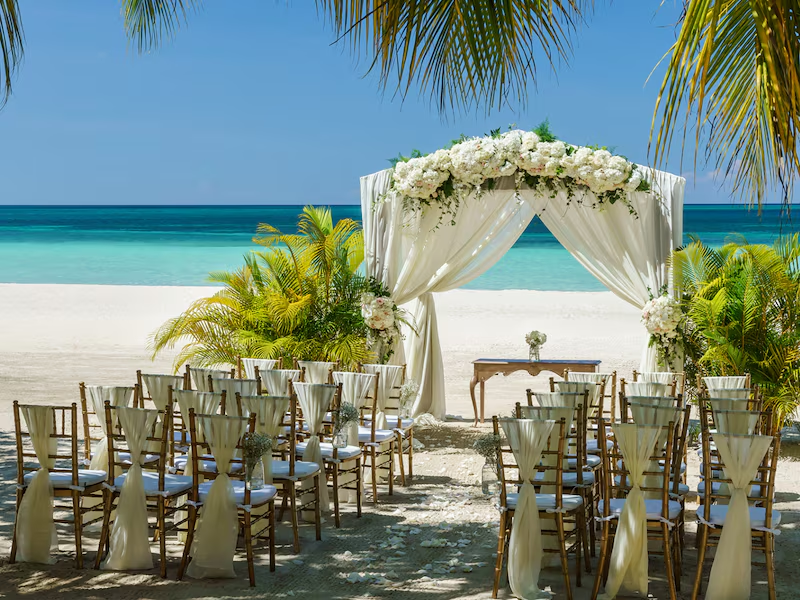
A typical all-inclusive wedding package at a mid-tier resort covers: a wedding coordinator on-site, ceremony setup with chairs and floral arch, food and drink for the reception, some standard decor, reception setup with tables and linens, and the officiant fee.
You are usually adding on: photography, upgraded flowers, DJ or live music beyond a basic sound system, hair and makeup, and premium menu tiers. Even with those add-ons stacked in, most couples I plan for land between $5,000 and $15,000 total, including their own trip.
The savings aren't a trick. You're just buying fewer things and coordinating with fewer people.
Why weddings genuinely cost less in Mexico and the Caribbean
3 real reasons the math works out this way. None of them are magic.
Reason 1: labor costs. A wedding coordinator, chef, or server at a resort in Mexico or Jamaica earns a fraction of what the same role earns in the USA. That difference gets passed through to your invoice. It's the single biggest driver.
Reason 2: all-inclusive pricing. When your resort covers food, drinks, and activities in the nightly rate, the reception isn't sold to you as a separate $12,000 catering event. It's already inside the room rate you and your guests are paying. The resort is monetizing the room block, not the plate count.
Reason 3: free wedding packages tied to room blocks. Almost every major resort brand runs a version of this. Book 5 to 10 rooms for at least 3 nights, get the ceremony free. Book 15 to 25 rooms, get a free ceremony plus free reception setup, free room nights for the couple, and often spa credits, dinner reservations, or a room upgrade. I've had couples get their entire ceremony comped because their guest count was strong.
The real number: $5,000 to $15,000 vs. $30,000+
Let me put actual budgets side by side.
USA wedding, 100 guests, mid-market: venue $10,000, catering and bar $30,000, flowers $5,000, DJ $3,500, photographer $5,000, planner $4,000, everything else $5,000. Total: roughly $62,500. Trim aggressively and you might get to $35,000.
Mexico all-inclusive wedding, 40 guests staying at the resort, mid-tier property: your wedding package with upgrades $6,000, photography add-on $2,500, your own 5-night stay $2,500, hair and makeup $600, tips and small extras $800. Total: roughly $12,400. Your guests pay for their own rooms, which they'd do at home anyway when they travel to your USA wedding.
The 40 vs. 100 guest gap is real. Destination weddings shrink guest lists by design. That's a savings driver too. Fewer plates, fewer chairs, fewer favors.
What your guests actually pay
This is where a lot of couples get anxious. "My cousin can't afford a plane ticket to Mexico."
Here's the reframe. Your guests at a USA wedding are already spending real money. Hotel for 2 nights, gas or a flight, meals off-property, a wedding gift, an outfit, sometimes childcare. That easily runs $500 to $1,500 per person.
Your guests at an all-inclusive destination wedding pay a flight and a room rate. Everything else is included. No dinner bills, no bar tabs, no Uber to the reception, no coffee run in the morning. The total often comes out lower than 3 nights at a boutique hotel in a USA wedding city, especially when the room block includes taxes and gratuities.
They also get a real vacation instead of a Saturday drive home. That's usually the part guests notice by the end of the week.
6 real budget tips from planning 300+ of these
These are the moves that actually shift the numbers, in the order I recommend them.
1. Book during shoulder or low season. May, June, September, and early December are lower-demand months at most Mexico and Caribbean resorts. Room rates drop 15 to 30 percent. Wedding packages sometimes get promotional pricing too.
2. Use a group booking. 10 rooms gets you group rates. 25 rooms gets you better group rates plus perks. Don't let guests book one-off unless they have to.
3. Ask about the free wedding tier. Every major brand has one. Ask what room count and length of stay triggers it, in writing, before you sign anything.
4. Keep decor simple. You're on a beach. Extra floral installations photograph beautifully in a Chicago ballroom because the ballroom is beige. On a Riviera Maya beach, you're competing with the ocean. Simple wins.
5. Skip a few of the add-ons. Photobooth, choreographed first dance rehearsal, individual guest gifts. Nice, not essential.
6. Work with a destination wedding planner, not a general travel agent. This is a specialty, and the fee is almost always covered by the resort commission, not by you.
For more tactical savings, see the full cost-cutting guide.
The "free wedding" fine print, honestly
Not every "free" wedding package is actually free. This is where couples get burned when they book direct without a planner.
What's usually included in the free tier: officiant, basic ceremony setup, a simple bouquet and boutonniere, a cake for the couple, sparkling wine toast for the couple. Sometimes a very short reception setup.
What's usually not included, even in "free" packages: a private reception space (you may be eating at a regular resort restaurant with other guests around you), premium menu upgrades, hair and makeup, photography, videography, extra floral, a full sound system for the reception, and legal marriage paperwork if you want to be legally married in-country.
Ask for the itemized inclusion list in writing. Then ask what a comparable "symbolic" ceremony costs without the free tier. Compare. Sometimes the paid package with fewer restrictions is cheaper once you add up the à la carte items you were going to buy anyway.
There's a full breakdown of these traps in our 10 extra destination wedding costs guide.
Where the numbers get closer than you'd think
I'll be honest: not every USA wedding is $60,000, and not every destination wedding is $10,000.
A backyard USA wedding with 30 guests, home-catered, no DJ, and a family friend officiating can land at $8,000. A destination wedding at Rosewood Mayakoba or the St. Regis Punta Mita for 30 guests with premium photography, private reception, and multi-day events can easily push $40,000.
The comparison isn't cheap vs. expensive. It's what your dollar buys.
In the USA at $30,000, you're buying a 5-hour event. In Mexico at $30,000, you're buying a 4-day event at a luxury property with your closest 40 people, all meals and drinks covered, and a honeymoon that starts the moment your guests leave. Different products.
If you're weighing this against a specific country, our Mexico destination weddings breakdown covers why Mexico is the most common starting point.
Shanna's final take
You can save real money without sacrificing the wedding you want. That's the honest version.
A destination wedding trades the 200-person USA reception for a 40-person 4-day experience, with better value per dollar and fewer things to coordinate. Some couples read that and feel relief. Others read it and miss the big local wedding. Both are fine answers.
If the money is the deciding factor, the math clearly favors Mexico or the Caribbean. If the guest list is the deciding factor and you cannot cut it below 100, the USA usually wins on total cost even at a higher per-plate rate. Pick your priority first, then let the number follow it.
Honest verdict
- Best for
- Couples with a 20 to 60 guest list, a $10,000 to $20,000 total budget, and a preference for spending the money on experience over decor. This is where destination weddings crush USA weddings on value.
- Not ideal for
- Couples with a 150+ guest list they can't or won't cut, or couples whose non-negotiable is a specific USA venue like a hometown church or family property. Trying to force 150 guests to fly abroad usually costs more than a hometown reception.
- What I'd choose instead
- If the money matters but travel doesn't work for your guest list, look at driveable USA destinations (Charleston, Savannah, the Finger Lakes, coastal Maine) with lower per-plate rates than major-metro venues. You'll land somewhere between the two extremes.
By Shanna Fowler, Certified Destination Wedding Planner and Travel Advisor.
WorldWide Destination Weddings is a niche division of WorldWide Travel Team, founded by Shanna Fowler and Ted Zinselmeier. We help couples plan all-inclusive destination weddings in Mexico, Jamaica, Costa Rica, the Dominican Republic, and beyond, with expert resort guidance, room block support, and guest travel logistics.
Frequently asked
Is a destination wedding really cheaper than a USA wedding?
In most cases, yes. A USA wedding with 100 guests typically runs $30,000 to $60,000. A destination wedding in Mexico or the Caribbean with 30 to 50 guests typically runs $5,000 to $15,000 total, including your own trip. The savings come from all-inclusive resort bundling, lower local labor costs, and free wedding packages tied to guest room blocks.
What's actually included in a resort wedding package?
A standard mid-tier package usually covers an on-site coordinator, ceremony setup with chairs and a floral arch, basic reception setup, food and drink for the wedding meal, and the officiant fee. Photography, upgraded flowers, DJ, hair and makeup, and premium menus are almost always separate. Ask for the itemized list in writing before you book.
Do my guests really save money at an all-inclusive destination wedding?
Usually yes, when you compare apples to apples. A guest at a USA wedding pays for a hotel, meals, drinks, transportation, and a wedding gift, which routinely hits $500 to $1,500. A guest at an all-inclusive resort pays a flight and a room rate that covers meals, drinks, and activities. For most guests, the destination total is similar or lower, and they get a vacation instead of a drive home.
How does a "free wedding" package actually work?
Resort brands offer free ceremony packages when you book a minimum number of guest rooms for a minimum number of nights. Typical thresholds are 5 to 10 rooms for 3 or more nights. What's included varies: some cover only the ceremony, others add reception setup and room nights for the couple. Always get the specific inclusions and exclusions in writing before you commit to a room block.
When is a USA wedding still the cheaper option?
When your guest list is 150+ and you can't or won't cut it. Once you're paying for 150+ flights, room blocks, and destination travel logistics, a hometown reception at a moderate USA venue usually comes out lower. Destination weddings win on value at 20 to 80 guests. Above 100, the math tightens fast, and above 150 the USA typically wins.