Two different jobs, not two versions of the same job
This is the question I get on almost every discovery call. "The resort already gives us a coordinator, so why would we hire a planner too?"
Fair question. The short answer: they do different jobs, at different points in the timeline, for different bosses.
A resort coordinator is on the resort's payroll. They run 60 to 150 weddings a year at that property, and their job is to execute the resort's package cleanly on the day. An independent destination wedding planner is on your side of the table. Their job is the 12 to 18 months of decisions before the coordinator ever picks up your file.
Once you see it that way, the "should I hire both" question mostly answers itself.
What a resort coordinator actually does
Resort coordinators are good at what they do. I've worked with dozens of them across Mexico, Jamaica, Costa Rica, and the DR, and the strong ones are the reason a ceremony runs on time and a reception flows.
Here's what falls inside their lane: the ceremony setup on the resort's approved venues, the resort's preferred vendor list for cake, flowers, music, and photography, the reception dinner using the resort's menus, and the day-of timeline once you arrive on property.
Here's what falls outside their lane: choosing which resort you should book in the first place, negotiating your contract or room block, tracking your budget across 12 months, coordinating guest flights and transfers, and running anything off the resort's property.
You usually don't get assigned a specific coordinator until 60 to 90 days out. Before that, you're talking to a central wedding sales inbox that answers in 3 to 7 business days. That gap is the piece most couples don't realize until they're 8 months out with 40 questions and no reply.
What an independent destination wedding planner does
An independent planner starts the day you sign with them, usually 12 to 18 months out.
The core work: matching your budget, guest count, and vibe to the right 2 or 3 resorts (not the 40 you'd find on Google), reviewing the wedding contract line by line before you sign, locking in a real room block with actual concessions instead of a vague group rate, tracking every guest RSVP and flight, and standing between you and the resort when the resort's answer to a question is "no."
The part most couples underrate: a good planner knows which "included" package items are actually included, which ones cost $600 to swap out, and which resorts hide $2,000 of upcharges in the fine print. That knowledge is not on any brochure.
For the fuller breakdown of what to look for in a planner once you decide you want one, my guide on choosing a destination wedding planner covers the 5 questions I'd ask before signing.

The 4 real benefits of hiring an independent planner
Not marketing benefits. Actual dollars-and-hours benefits I watch pay off on every wedding.
1. A custom wedding beyond the resort's package. Resort packages are built for the resort's operational ease, not for your day. A planner knows which items you can swap out for the same price, which upgrades are worth it, and which ones the resort will comp if you ask the right way.
2. Contract and budget protection. I've seen resort contracts that quietly cap your room block release date at 45 days, when the industry norm is 30. That single clause can cost a group of 40 guests around $8,000 in penalty room nights. A planner catches that before you sign.
3. Trusted outside vendors. The resort's preferred photographer is fine. The photographer I'd send to your resort based on 10 years of watching their work is often better and 20 to 30 percent cheaper. Same for florists and outside DJs.
4. Guest travel and logistics. Booking 40 people across 12 flights, 3 airports, and 2 airport transfers is a part-time job for 3 months. A planner runs that so you don't.
When you actually need both
Here's the honest cut. Some couples truly don't need an independent planner. If your guest count is under 20, you're taking the resort's standard package as-is, you have zero off-property events, and your budget is under about $8,000 all-in, the resort coordinator alone can carry the whole thing.
Everyone else benefits from having both, and 3 specific situations make it non-negotiable.
Off-resort events: welcome dinners, private catamarans, cliffside receptions
The moment you want anything outside the resort's property line, the resort coordinator's authority ends.
Want a welcome dinner at a local seafood spot in Playa del Carmen? Off-property. Cliffside cocktails on the Costa Rica coast the night before? Off-property. Private catamaran sunset sail in Negril for 20 guests? Off-property.
The resort coordinator can't book those, can't vet the vendor, and can't coordinate the transport. An independent planner does all 3 as normal Tuesday work.
This is also where legal ceremony logistics live. If you want to legally marry in Mexico or the DR (not just have a symbolic ceremony), the paperwork and residency requirements are a planner's job, not the resort's. My legal requirements guide walks through what each country actually requires.
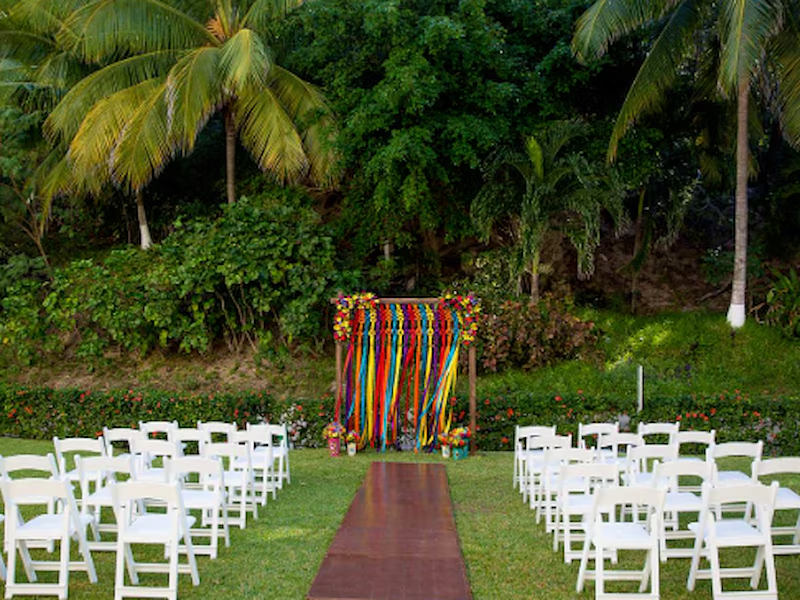
Complex plans: 40+ guests, multi-day timelines, or 2+ venues
A resort coordinator runs a ceremony and a reception. They don't run a 4-day event.
If your group is 40 or more, or your weekend has a welcome party, a rehearsal dinner, a ceremony, a reception, and a farewell brunch, you have 4 to 5 mini-events plus airport logistics. That's too much for a coordinator whose job is on-property day-of.
A planner builds the master timeline, keeps decor consistent across venues, tracks each event's headcount separately, and makes sure the coordinator gets a clean brief for the ceremony and reception pieces they'll run.
The same is true for detail-heavy weddings. Custom signage, welcome bags, escort cards, a curated playlist, a specific processional order. None of that is inside the resort coordinator's scope. It has to come from someone.
Full support from idea to homecoming
Some couples want a hand on the wheel from the first Pinterest board to the last guest's Uber home. That's a legitimate reason to hire a planner too.
For couples who are running a business, raising kids, or planning a wedding across time zones, the calm of "a professional is watching this" is worth the fee on its own. I've had couples tell me the planning process itself was the wedding gift.
That level of support is not what a resort coordinator can offer, because it's not their job.
So what does it actually cost to hire both?
The resort coordinator is included in your wedding package. You're already paying for them whether you know it or not.
An independent planner is a separate line item. On the destination wedding side, planner fees typically run $2,500 to $6,000 for a small-to-mid wedding, and $6,000 to $12,000 for larger groups or multi-day events. Some planners (including our team) fold the fee into the group travel booking so couples pay nothing extra out of pocket, because the fee is covered by the resort's standard travel-advisor commission on the room block.
That structure is worth asking about on your first call. "How are you paid, and is there a separate planning fee on top?" is a fair question. My planner selection guide covers exactly what to ask.
Shanna's final take
Resort coordinators are good at their job. The best ones save a wedding day when a florist runs late or a rain plan has to trigger 90 minutes before ceremony.
They just aren't the same as an independent planner, and it's not a fair fight to expect them to be. They work for the resort, on a 60 to 90 day window, on the resort's approved venues, using the resort's approved vendors. That is the job.
An independent planner works for you, on a 12 to 18 month window, across every venue and vendor and country. That is a different job.
For weddings under 20 guests with a stock package and no off-resort events, one is enough. For everything else, hiring both is not a splurge, it's how the math works.
Honest verdict
- Best for
- Couples with 20+ guests, any off-resort event, a budget above about $10,000, or any part of the wedding where they want independent advocacy on contracts, room blocks, and vendors. Also anyone who values a real human answering emails within a day between now and the ceremony.
- Not ideal for
- Small ceremonies of 10 to 20 guests taking the resort's standard package as-is, with zero off-property plans and a total budget under $8,000. In that case, the resort coordinator alone is usually enough, and paying a planner would be paying for capacity you don't need.
- What I'd choose instead
- If a full-service planner feels like too much, ask a travel advisor to at least book the room block and handle guest travel logistics for you. That gets you the group-travel piece (often at no fee) without a full planning engagement, and you can hand the wedding-day details to the resort coordinator.
By Shanna Fowler, Certified Destination Wedding Planner and Travel Advisor.
WorldWide Destination Weddings is a niche division of WorldWide Travel Team, founded by Shanna Fowler and Ted Zinselmeier. We help couples plan all-inclusive destination weddings in Mexico, Jamaica, Costa Rica, the Dominican Republic, and beyond, with expert resort guidance, room block support, and guest travel logistics.
Frequently asked
Does the resort's wedding coordinator cost extra?
No. The resort coordinator is folded into whichever wedding package you book, from the free complimentary packages up to the $10,000+ premium ones. You don't pay them separately, and you don't tip them the way you'd tip a bartender. Their compensation is between them and the resort.
How early do I actually get assigned my resort coordinator?
At most Mexico and Caribbean all-inclusives, you're assigned a specific coordinator 60 to 90 days before your wedding date. Before that window, questions go through a central wedding sales inbox that typically answers in 3 to 7 business days. That's why couples who book 12 to 18 months out often feel like nobody's home for the first 9 months. An independent planner fills that gap.
Can a destination wedding planner get me a better price than booking direct?
Usually yes on the room block, sometimes yes on the wedding package, and often yes on outside vendors. Group rates for 10+ rooms almost always beat public rates, and a good planner negotiates the room block terms (release date, attrition, comp nights) on top of the price. On the wedding package itself, the savings come from knowing which upgrades to swap and which perks to ask for, not from a raw discount.
What if my planner and the resort coordinator disagree about something?
That's actually the whole point of hiring a planner. When the resort says "no, we can't do that," your planner is the one who pushes back with, "okay, what would it take to make it work?" I've had that conversation about ceremony times, cocktail-hour locations, plated dinner options, and outside vendor rules more times than I can count. About 80 percent of the time, the answer changes.
How do I decide whether I need both a coordinator and an independent planner?
Answer 4 questions. Is my guest count above 20? Do I want any event outside the resort? Am I planning any custom detail beyond the standard package? Is my total budget above about $10,000? If you answered yes to any 2 of those, you want both. If you answered no to all 4, the resort coordinator alone is fine.