Step 1: decide your ceremony type first, everything else follows
Before falling for a ceremony photo, decide whether you want the legal marriage at the destination or a symbolic celebration with the legal process handled separately.
A symbolic celebration does not itself create a legal marriage. Ask the venue what permissions, officiant arrangements and proof it requires. For a legal ceremony abroad, confirm eligibility, documents, authorized officiants and timing with the responsible local authority; a rule in one country or state is not a rule everywhere.
The State Department's marriage-abroad guidance is a useful starting point. Your travel advisor can help coordinate the logistics, while the authority or a qualified lawyer confirms the legal details.
Step 2: match the season to the region, not the other way around
Check the exact location, not just the country name. Los Cabos, Puerto Vallarta and Cancun do not have identical rainfall patterns, and no month is weather-proof.
The National Hurricane Center lists Atlantic hurricane season as June 1 through November 30 and eastern Pacific season as May 15 through November 30. Those basin-wide dates do not predict conditions at your resort, and storms can occur outside them.
For Costa Rica, use region-specific climate guidance: the Pacific and Caribbean sides have different patterns. Whatever the date, confirm an acceptable weather backup, its capacity and any extra charges before booking.
Step 3: set your total budget before you look at any resort
Set the number before you start justifying upgrades. Include the ceremony and reception, photography, hair and makeup, your travel, private events, planning fees, taxes, service charges and a contingency you are comfortable with.
Don't assign an entire hotel brand to a fixed wedding-budget tier. Your date, guest count, event choices and rooms change the quote. A resort package and an offsite venue can both work; compare complete proposals including rentals, permits, transfers and vendor fees.
Keep the couple's budget separate from what guests will pay. Our USA versus destination cost comparison shows how to make that comparison without mixing different guest counts.
Step 4: define the venue vibe, then filter
Now (and only now) you get to talk about aesthetics. What does the wedding actually look like in your head?
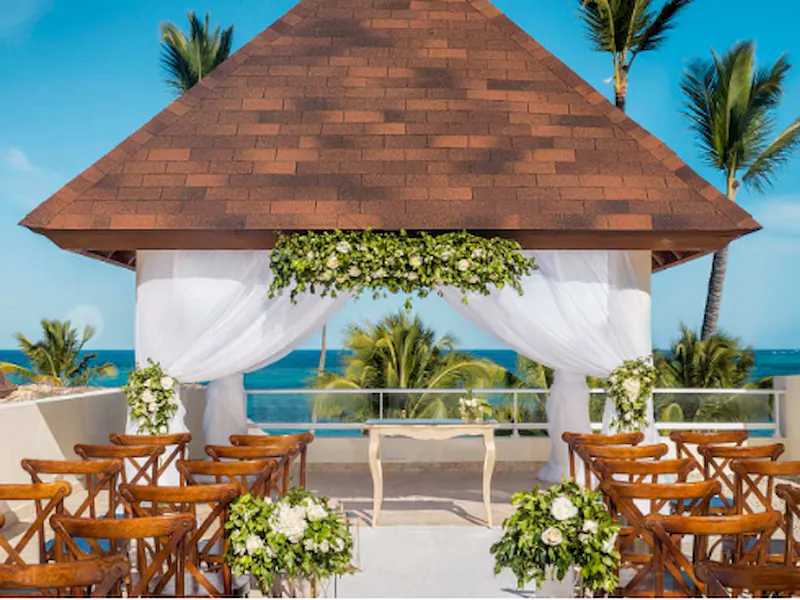
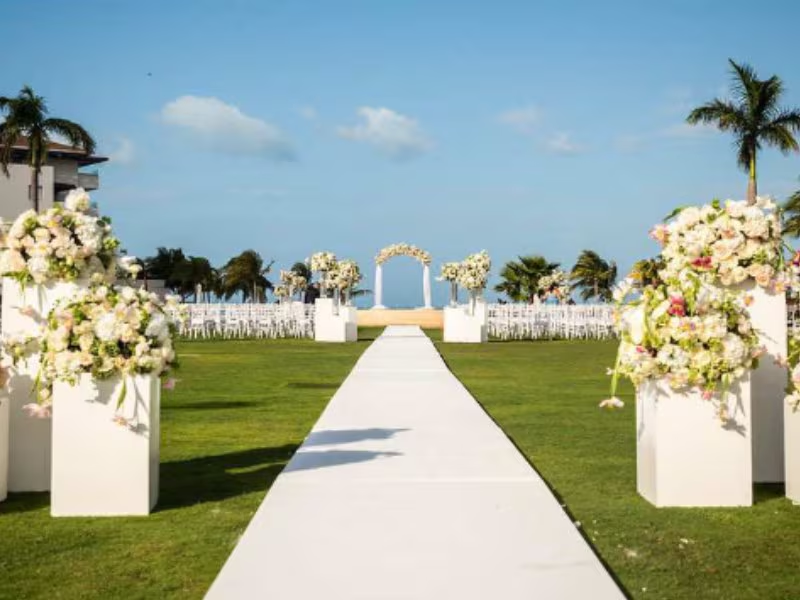
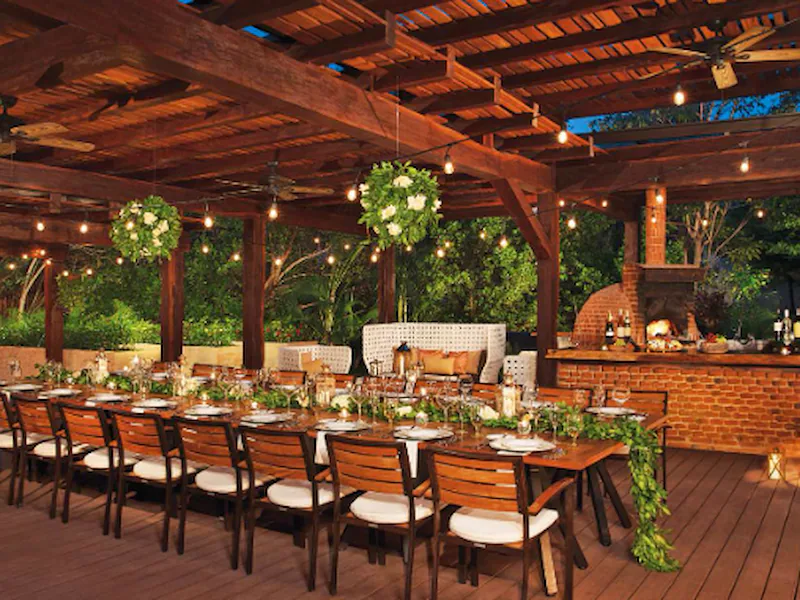
Small beach cabana with 20 guests barefoot in the sand? That's a different property than a formal garden ceremony for 100. Sunset ceremony on a cliff with a rooftop reception? Different again.
Answer these 4 questions in writing before you shortlist anything: How many guests, realistically? Beach, garden, terrace, cliff, or rooftop? Formal or casual? Do you want everyone staying at the same resort or are you okay splitting?
Guest count filters the shortlist quickly. Ask about the usable capacity for your specific ceremony and reception layout, including dining, dancing, accessibility and the weather backup. A venue's maximum number is not always the comfortable number for your plans.
Step 5: narrow to 3 or 4 real options, then compare line by line
This is where a lot of couples freeze. They'll look at 20 resorts, save 50 Instagram posts, and end up more confused than when they started.
Cut it to 3 or 4 properties. That's the sweet spot. Fewer and you don't know what you're missing; more and you can't hold the details in your head.
Ask each property for the same essentials: an itemized proposal, included guest count, extra-person charges, private-event and outside-vendor fees, backup arrangements, taxes and service charges, and any room-block benefit conditions. Get the current coordinator contact too.
Put those 5 answers in a simple side-by-side table. The winner usually becomes obvious once the numbers are next to each other. If you want the full script for that conversation, our questions to ask the venue coordinator guide gives you the exact prompts I use.
The mistakes I see couples make on this specific step
A few mistakes are easy to avoid once you know to look for them.
1. Treating a lower room quote as a guarantee of savings. Compare the same room, occupancy, nights, inclusions and event choices. Check weather and backup arrangements for the actual date.
2. Choosing a legal ceremony before checking the requirements. Ask the responsible authority before committing to the date.
3. Ignoring guest travel costs. Price representative trips from the airports your guests use, including transfers, baggage and the number of nights required.
4. Keeping too many options alive. I prefer three or four serious contenders once the practical filters are clear.
For more, see our destination wedding mistakes guide.
Resort first or venue first?
I usually start with the overall guest experience, then check the ceremony and reception venues. But both need to work before you commit. A great resort does not compensate for a venue that is too small, inaccessible or unavailable on your date.
Compare the two together. The resort or venue first guide explains that conversation.
Shanna's final take
These five steps give the search a useful order: ceremony type, season, budget, venue needs, then a side-by-side shortlist. They won't choose the wedding for you, but they keep the practical questions visible.
The couples who feel calm about their choice by the end are the ones who filtered ruthlessly at each step. The couples who feel anxious about their choice are usually the ones who tried to compare 20 resorts on Instagram before deciding whether they even wanted a legal ceremony.
Do the boring work first. The exciting part (looking at real properties) is much more fun once the filters have done their job.
Honest verdict
- Best for
- Couples ready to define ceremony type, weather priorities, total budget, guest needs and venue style before comparing properties.
- Not ideal for
- Couples who want to keep every option on the table until the last minute. That approach makes for beautiful Pinterest boards and painful planning. The whole point of this list is to close doors early so the remaining ones actually match your wedding.
- What I'd choose instead
- If you need help narrowing the options, compare what each advisor or planner actually includes and charges. Our <a href="/packages">planning packages</a> explain WWDW's paid services; a consultation is not the same as full-service planning.
By Shanna Fowler, Certified Destination Wedding Planner and Travel Advisor.
WorldWide Destination Weddings is a niche division of WorldWide Travel Team, founded by Shanna Fowler and Ted Zinselmeier. We help couples plan all-inclusive destination weddings in Mexico, Jamaica, Costa Rica, the Dominican Republic, and beyond, with expert resort guidance, room block support, and guest travel logistics.
Frequently asked
What's the first decision I should make when choosing a destination wedding location?
Decide whether the legal marriage will happen at the destination or separately from a symbolic celebration. Then confirm the applicable authority and venue requirements before committing.
When is the safest season to have a destination wedding in Mexico or the Caribbean?
There is no universally safest month for every destination. Compare local climate patterns, storm-season exposure, guest comfort and a confirmed weather backup. Neither November nor any other month is a guarantee.
How many resorts should I compare before deciding?
3 or 4. Fewer and you don't know what you're missing. More and you'll drown in details. Ask each property for the same 5 items in writing (itemized package, per-guest reception cost, private-event fee, free-wedding room-block threshold, coordinator contact) and put them in a side-by-side table.
Is a resort or an offsite venue usually cheaper?
Neither is always cheaper. Compare complete written quotes with the same guest count, events, inclusions, travel, taxes and fees. A low venue-rental price alone is not a total wedding budget.
Do I need a destination wedding planner to choose a location?
A planner or travel advisor can help shortlist and coordinate, but services and fees vary. WWDW offers paid flat-rate packages; see <a href="/packages">our package details</a> for scope. Don't assume supplier commission makes planning free or guarantees savings.